If you’ve ever shopped for custom promotional products and encountered the phrase, “Minimum order: 250 units,” you’ve run into an MOQ — a Minimum Order Quantity. For small businesses, nonprofits, and event planners who only need a handful of branded items, MOQs can feel like a barrier. But once you understand how they work — and how to work around them — you’ll find that ordering custom promo products in smaller quantities is more doable than you think.
KEY TAKEAWAYS:
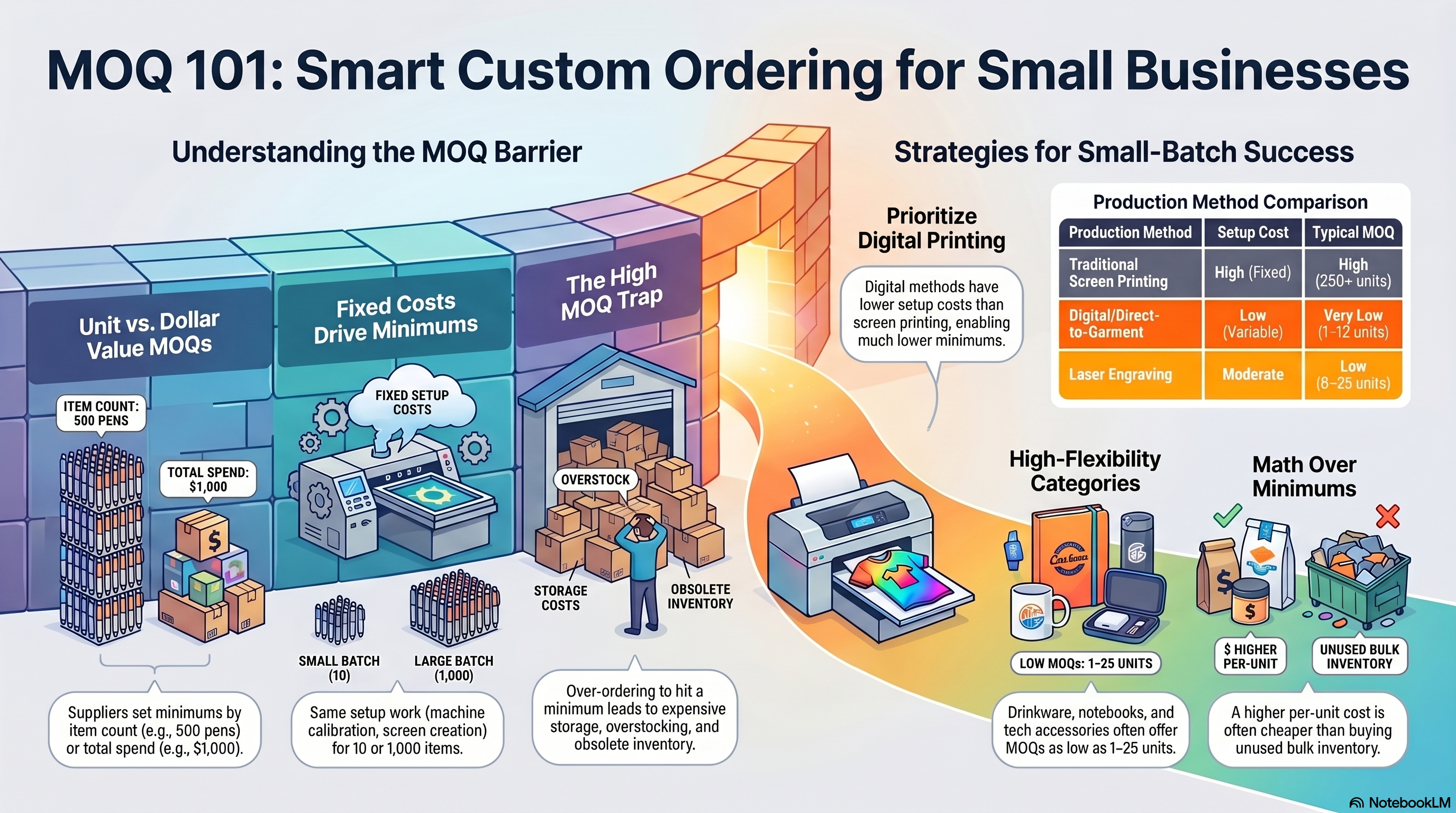
- MOQ (Minimum Order Quantity) is the smallest batch a supplier will produce in a single production run — set as a unit count or a minimum dollar amount.
- MOQs exist because custom setup costs (screens, embroidery machines, molds) are fixed — more units means that cost is spread thinner per item.
- Buying low-MOQ products typically costs more per unit but saves you from excess inventory, storage costs, and wasted spend.
- Digital printing and embroidery methods tend to have far lower minimums than traditional screen printing.
- Popular low-MOQ promo items include branded drinkware, tote bags, notebooks, pens, and tech accessories like chargers and USB drives.
- Amsterdam Printing offers a dedicated low-minimum product catalog — with options starting as low as 1–25 units across dozens of categories.
What Is an MOQ?
MOQ stands for Minimum Order Quantity — the smallest number of units (or minimum dollar value) a supplier will accept for a single production run. In the promotional products world, this number is set by manufacturers to ensure that the cost of custom setup is worthwhile for everyone involved.
Think of it this way: Every time a supplier produces a custom item — say, a pen with your company logo — there’s setup work involved before a single unit is made. Screens must be created, machines calibrated, and artwork files processed. That overhead cost is the same whether you order 10 pens or 10,000. MOQs exist to make sure the math works out.
MOQs generally take one of two forms:
- Unit Volume MOQ: You must order at least a certain number of items — e.g., a minimum of 500 branded notebooks per order, regardless of total cost
- Dollar Value MOQ: Your order must reach a minimum spend — e.g., $1,000 total — no matter how many units that works out to.
Most promotional product suppliers use unit-based MOQs, although dollar-value minimums are common in wholesale and direct-manufacturer relationships. When you shop with a retailer like Amsterdam Printing, you’ll typically see per-item minimums listed right on the product page.
Why Do MOQs Exist? (The Business Case)
MOQs aren’t arbitrary — they reflect the real economics of custom manufacturing. When a supplier sets up a screen-printing job, for example, they may spend 30–60 minutes on artwork processing, screen creation, and machine calibration before the first item is ever printed. That time represents a fixed cost. If they only print 10 shirts, that setup cost is enormous per shirt. If they print 500, it’s nearly invisible on a per-unit basis.
The result: Lower MOQs typically mean higher per-unit costs, and vice versa.
How to Buy Small Quantities Without Overpaying
Ordering fewer items doesn’t have to mean throwing money away on inflated unit costs. Here are the most effective strategies for getting custom promo products in smaller quantities — smartly.
- Seek out no-minimum or low-minimum vendors. Some suppliers specifically cater to small-batch orders. Amsterdam Printing’s dedicated low-minimum catalog makes it easy to browse products by small order size — no digging required.
- Choose digital printing over screen printing. Digital (direct-to-garment or digital transfer) printing has dramatically lower setup costs than traditional screen printing, which is why it accommodates lower minimums. If you’re ordering apparel in small quantities, DTG is your friend.
- Ask to negotiate. Many suppliers will lower their MOQ if you’re willing to pay a slightly higher per-unit cost. It doesn’t always work, but it’s worth asking — especially for repeat customers.
- Bundle for future use. If the MOQ is 200 units but you only need 50 now, consider whether the other 150 could serve a future campaign, trade show, or employee onboarding kit. Buying to the MOQ at a lower per-unit price often costs less than a specialty small-batch run.
- Shop low-minimum product categories intentionally. Certain products are designed for small-batch ordering. Drinkware, notebooks, keychains, and tech accessories often have minimums as low as 1–25 units — no negotiation needed.
The Pitfalls of High MOQs (and How to Avoid Them)
If you order far more than you need just to hit a supplier’s minimum, you’re not saving money — you’re just pushing costs into a different bucket. Here are the most common traps:
- Overstocking: You may end up with 450 branded pens for a 50-person event — items that sit in a box indefinitely.
- Storage costs: Large quantities of unused swag take up real space, and in some cases require climate-controlled storage.
- Obsolescence: Rebrand your logo or change your phone number? Those leftover items become instantly unusable — and expensive to dispose of.
Remember, a slightly higher per-unit cost on a small-batch order is often cheaper in the long run than over-ordering to hit a low per-unit price. Do the actual math for your situation before assuming bulk is always better.
Best Low-MOQ Promotional Products to Order in Small Quantities
Fortunately, some of the most popular and effective promo items are well-suited to small-batch ordering. Here’s a look at categories where you’ll find the most flexibility — and the most variety.
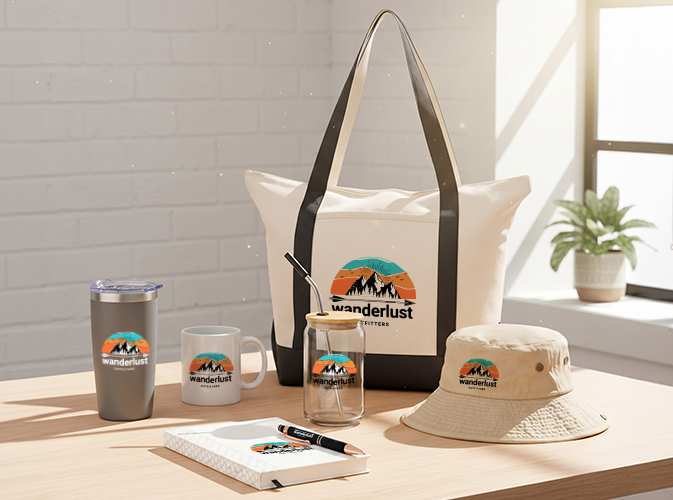
- Drinkware (tumblers, mugs & water bottles): Insulated tumblers and ceramic mugs are perennial favorites. Many can be ordered in quantities as low as 6–12 units with laser engraving or full-color printing.
- Bags & apparel (totes, drawstring bags & hats): Tote bags and drawstring backpacks often have minimums of 12–25 units. Embroidered hats and polos are popular for small team kits and executive gifting.
- Office & tech (notebooks, pens, USB drives): Classic desk-friendly giveaways available in small quantities. Notebooks and journals can often be ordered in batches of 25 or fewer with full custom covers.
- Eco-friendly items (reusable bags & sustainable materials): Increasingly popular for mission-driven brands. Many sustainable items are available in low MOQs because they’re produced using digital methods.
- Unique & specialty items (keychains, tape measures, photo items): Unexpected giveaways that stand out. Personalized photo items like blankets or pillows can sometimes be ordered one at a time — ideal for VIP or executive gifting.
- Tech accessories (chargers, mouse pads & earbuds): Tech-forward items that appeal to modern audiences. Many are available in small batches, making them a practical choice for client gifts, incentive programs, or new hire kits.
A key advantage of shopping low-MOQ is flexibility. Rather than ordering 500 of one item, you can order 25 of ten different products — giving your audience a branded swag bag experience without the warehouse commitment.
A Few Things to Consider Before You Order
Shopping for low-minimum promo products is straightforward, but keep a few practical pointers in mind:
- Per-unit pricing will be higher. That’s expected and often still the smarter financial choice once storage and waste are factored in. Run the numbers honestly.
- Rush production is often available. Many suppliers offer expedited turnaround on low-MOQ items — especially digitally printed products — which is useful when you’re working against a tight event deadline.
- Variety is a feature, not a compromise. Ordering small quantities of multiple products lets you test what resonates with your audience before committing to a large run. Think of it as low-stakes market research.
Armed with these considerations, you're in a great position to order confidently — without overcommitting your budget or your storage closet.
FAQs:
-
What does MOQ mean in promotional products?
MOQ stands for Minimum Order Quantity — the smallest number of units (or minimum dollar value) a supplier will accept for a single custom production run. In the promotional products industry, MOQs exist because custom printing or embroidery involves fixed setup costs that only make economic sense when spread across enough items. For example, a supplier might set an MOQ of 250 units for screen-printed t-shirts to ensure the screen creation and press setup costs are covered.
-
Can I order promotional products with no minimum order quantity?
Yes — many suppliers, including Amsterdam Printing, offer products with very low or no traditional minimums, often enabled by digital printing technology which requires little to no physical setup. Product categories like personalized drinkware, photo-printed items, and select apparel can sometimes be ordered in quantities of just 1–12 units.
Browse Amsterdam Printing’s low-minimum catalog here.
-
Why are promotional products cheaper in larger quantities?
The per-unit cost drops as quantity increases because the fixed setup cost — artwork processing, screen creation, machine calibration — is spread across more units. Order 10 items and that setup cost might represent $5 per unit. Order 500 and it’s cents per unit. This is why bulk orders look more attractive on a per-item basis, though they come with tradeoffs like upfront cash outlay, storage requirements, and the risk of unused inventory.
-
What are the best promotional products to order in small quantities?
The best low-MOQ promo items tend to be those produced using digital printing or laser engraving — methods that require minimal setup. Top choices include branded drinkware (tumblers, mugs, water bottles), tote bags, notebooks, pens, keychains, USB drives, and tech accessories like wireless chargers. These work well for small events, executive gifting, employee welcome kits, or testing new branded designs before committing to a larger run.
-
Is it worth paying more per unit for a smaller order quantity?
Often, yes — especially when you factor in the full cost of over-ordering. A higher per-unit price on a small batch may save money when you avoid storing hundreds of unused items, risk of rebranding making stock obsolete, and cash tied up in excess inventory. The right answer depends on your specific situation. Multiply the per-unit cost by the quantity you’ll use, not just the quantity you’d have to order to hit the MOQ.
Published: 6/11/26