The right promotional products help nonprofits thank donors, recognize volunteers, and spread their mission without overspending on overhead. This guide covers four core buyer scenarios — donor appreciation, volunteer recognition, fundraising event kits, and awareness outreach — with product recommendations, budget guidance, a decision framework, and what every nonprofit should know about donor gifts and tax implications. Every recommendation is chosen with cost-per-impression and reuse in mind, because in a mission-driven organization, how the money is spent is part of the message.
KEY TAKEAWAYS
- The best promotional products for nonprofits depend on the goal: silicone wristbands and pens for broad awareness, t-shirts and tote bags for volunteers, journals and tumblers for mid-tier donors, and blankets or gift sets for major donor milestones.
- Every branded item is a stewardship decision. Donors and supporters notice when their contributions are spent on something genuinely useful rather than something that ends up in a landfill.
- Supporters who wear or carry a nonprofit's branded item become ambassadors for the cause, generating impressions in their communities at no additional cost to the organization.
- Fundraising event kits built around a drawstring or tote bag, a water bottle, and a branded tee work for charity walks, galas, and auctions — practical enough to be used repeatedly after the event.
- Keep broad donor thank-you gifts inexpensive so they qualify under the IRS insubstantial-benefit safe harbor and don't reduce a donor's tax deduction. Verify current IRS thresholds annually.
- Personalization — a volunteer's name, a chapter identifier, an event year — significantly increases how long recipients keep and use a branded item.
Why Promotional Products Work Differently in Nonprofits
Promotional products in mission-driven organizations carry a different kind of weight. When a corporation hands out a branded tumbler, it's a marketing expense. When a nonprofit does it, supporters evaluate it as a stewardship decision — and they notice when their donations are spent thoughtfully versus carelessly. That accountability isn't a constraint; it's a challenge that produces better buying decisions.
The other reality that separates nonprofits from most buyers is that the same organization needs four very different types of merchandise simultaneously. Donor appreciation items need to feel personal and premium relative to the giving level. Volunteer swag needs to be practical and team building. Event kits need to balance per-unit cost against broad distribution. Awareness giveaways need maximum visibility at minimum spend. Managing all four with a single budget requires clarity about what each item is supposed to do.
The emotional dimension matters too. A supporter who wears a nonprofit's t-shirt to a farmers’ market or carries its tote bag to a grocery run is making an implicit public statement about what they care about. That kind of organic endorsement is something advertising can't manufacture — it comes from a genuine connection to the cause and a piece of merchandise worth using.
The 4 Buyer Scenarios for Nonprofits and Fundraising
Scenario 1: Donor Appreciation and Recognition
Donor thank-you gifts serve a specific purpose: they make the donor feel genuinely appreciated in a way that strengthens the relationship and increases the likelihood of a future gift. Getting this right requires tiering the gift to the giving level — a token gift for a broad annual-fund list communicates something different from a premium gift to a major donor who funded a capital project.
-
Broad donor list thank-yous: Inexpensive, branded items that qualify as IRS token gifts (see the tax section below) — custom pens, branded notebooks, and small journals. These should feel warm and mission-aligned without creating tax complications for the donor.
-
Mid-tier donor appreciation: Branded journals, insulated tumblers, and travel mugs that live on a desk or accompany a commute, keeping the organization's name visible throughout the year. These are appropriate for donors who give regularly and deserve more than a postcard thank-you. Shop travel mugs
-
Major donor and milestone gifts: Premium items — sherpa blankets, engraved drinkware sets, and curated gift boxes — that feel personal and celebratory rather than promotional. These are appropriate for capital-campaign donors, legacy giving announcements, and multi-year relationship milestones. Shop gift sets | Shop blankets
-
Personalization: Adding a donor's name, a milestone year, or a personal message to a gift transforms it from a branded item into a keepsake. Personalization significantly increases how long recipients keep and use an item — and how meaningful the gesture feels.
A note on tone: Donor appreciation gifts should feel like gratitude, not marketing spend. A large, prominent logo on a premium gift reads as promotional. A small, tasteful mark alongside the donor's name reads as personal. The distinction matters to donors who gave significant amounts.
Scenario 2: Volunteer Recognition and Team Apparel
Volunteers are the operational backbone of most nonprofits — and they frequently work without compensation, recognition, or even the sense that what they're doing is visible to anyone beyond the immediate event. A well-chosen piece of branded merchandise changes that. It signals that the organization sees their contribution, values their time, and wants them to feel like part of something.
-
Team t-shirts and caps: A branded t-shirt or cap turns a volunteer into a visible, unified presence at an event — immediately identifiable to attendees and to each other. This unity isn't just logistical; it's motivational. Volunteers who feel like part of a team show up more consistently and stay longer. Shop custom t-shirts
-
Volunteer welcome kits: A simple onboarding kit for new volunteers — a branded tote bag, a water bottle, a pen, and a notebook — communicates that the organization prepared for their arrival and values their involvement from day one. The tote bag does double duty as packaging and as an ongoing giveaway. Shop water bottles
-
Practical appreciation items: Water bottles, tote bags, and branded journals are the most-retained volunteer thank-you items because they fill a real need in daily life. A water bottle carried to the grocery store after a volunteer shift is a daily reminder of the cause — and a visible signal to everyone who sees it.
-
Milestone recognition for long-serving volunteers: Award plaques, lapel pins, and engraved desk accessories mark the contributions of volunteers who have given years of their time. These items are displayed, worn, and talked about in ways that a standard thank-you gift isn't. Shop award plaques
A simple rule for volunteer appreciation: The gift should feel like it was chosen for a person who gave their time, not assembled for a list. Items that acknowledge the specific role, the event, or the milestone communicate that someone paid attention — and that attention is often more meaningful than the item itself.
Scenario 3: Fundraising Event Kits
Fundraising events have multiple merchandise needs running simultaneously — registration items that build unity among participants, giveaways that increase perceived event value, sellable merch that generates additional revenue, and premium items for gala and auction settings where the presentation matters as much as the product.
-
Charity walks, 5Ks, and fun runs: Wristbands for registration and unity, a branded tote or drawstring bag as the registration-day kit, a water bottle for the route, and a t-shirt that participants wear through the finish line and beyond. These are practical items built for the day — and reusable enough to keep generating impressions for months afterward. Shop wristbands | Shop drawstring bags
-
Gala and auction events: Branded journals and pens at the registration table are practical and polished. A drinkware set or a premium gift box as a paddle-raise thank-you or a centerpiece giveaway elevates the event experience and gives attendees something they'll use long after the evening ends.
-
Sellable merchandise: Items supporters will buy at a booth or through an online store — branded tees, tote bags, drinkware, and cause-colored accessories — turn promotional products into a fundraising channel. Choose photogenic, mission-aligned items that supporters are proud to display and wear. Price them to cover costs with margin for the mission.
-
Event kit bundles: A drawstring or tote bag pre-loaded with a water bottle, a branded tee, and a wristband gives every participant a complete kit at a predictable per-person cost. These bundles increase perceived event value and ensure every participant leaves with your brand in their hands. Shop tote bags
Scenario 4: Awareness and Community Outreach
Community outreach giveaways serve a specific and valuable function: they put a cause's name, colors, and message in front of people who may not yet be donors or volunteers — and they turn supporters into visible ambassadors in their neighborhoods, schools, and workplaces. At parades, health fairs, community clean-up days, and awareness events, the goal is broad reach at the lowest practical per-unit cost.
-
Silicone wristbands: The most cost-effective awareness item available. Cause-colored, message-forward, and worn by recipients for days or weeks after the event. A wristband at a health fair or a parade generates impressions in every setting the wearer visits. Shop custom wristbands
-
Custom pens and lanyards: The workhorses of community-event distribution — inexpensive enough to hand out freely, useful enough to earn a place in daily life. A pen that ends up on a desk at home or in an office generates brand impressions for the organization every time it's picked up. Shop custom pens | Shop custom lanyards
-
Cause-colored t-shirts and caps: Wearables with clear mission messaging give supporters something they choose to put on in public — which makes every wearing a small act of advocacy. For awareness campaigns around specific causes (breast cancer, mental health, environmental initiatives), color-matched apparel carries meaning that a generic branded item can't match.
-
Reusable tote bags: Higher per-unit cost than a pen or a wristband, but the ongoing visibility justifies the investment when budget allows. A tote bag carried to a farmers’ market or a grocery store reaches an audience that no event can — the everyday public life of the supporter.
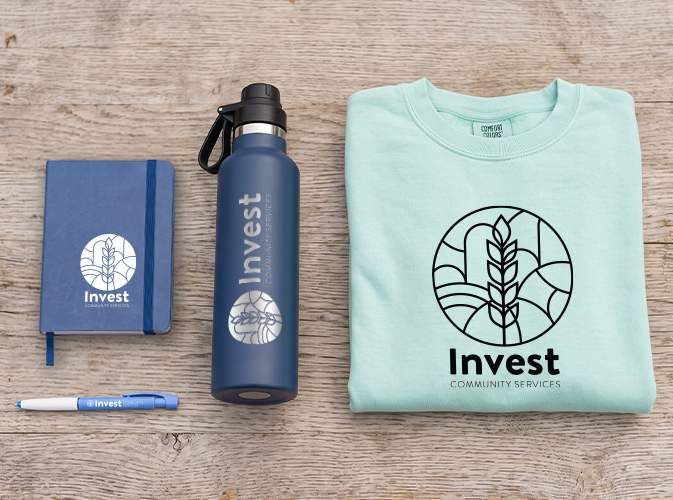
Best Product Categories for Nonprofits
Each of these categories earns its place in a nonprofit's promotional product toolkit because of its cost-per-impression relative to its per-unit cost and its reuse potential.
- T-shirts and apparel: Turn supporters into walking billboards for the cause. The most visible and emotionally resonant category in the nonprofit merchandise toolkit.
- Tote and drawstring bags: Reusable, high-visibility, and versatile across all four buyer scenarios — from volunteer welcome kits to event registration bags to community giveaways.
- Water bottles and drinkware: Practical daily-use items that earn long-term visibility at home, at the gym, and at the office. Among the most-retained items in any category.
- Silicone wristbands and pens: The lowest-cost awareness and crowd-giveaway options — effective at scale for parades, health fairs, and high-traffic community events.
- Journals and notebooks: Thoughtful mid-tier donor and volunteer thank-yous that live on desks and in bags for months, generating daily impressions in professional environments.
- Gift sets and blankets: Premium major-donor appreciation that feels personal and celebratory — appropriate for capital campaign donors, legacy giving announcements, and milestone recognition.
- Award plaques and lapel pins: Volunteer milestones, board recognition, and long-service thank-yous that get displayed, worn, and shared.
- Lanyards and keychains: Event access, staff identification, and everyday-carry items that keep the cause's name visible in practical daily contexts.
Matching the Gift to the Relationship: Stewardship and Budget
Every promotional product purchase a nonprofit makes is a stewardship decision — and treating it as one leads to better buying outcomes. The goal isn't to spend as little as possible or to impress with premium items; it's to match the quality and cost of the item to the relationship it's meant to strengthen.
- Price the gift to the relationship: under $1 for crowd giveaways at community events, $5 to $20 for volunteer kits, $10 to $30 for mid-tier donor appreciation, and $25 to $100 for major donor milestones.
- Favor reuse over novelty — items that earn a place in daily routines generate far more impressions over time than single-use giveaways that get discarded after the event.
- Buy in bulk for events to bring per-unit costs down, reserving premium pieces for high-value relationship moments where the investment is proportional.
- Eco-friendly and reusable options — recycled materials, organic cotton, sustainable packaging — resonate with values-driven supporters and communicate that the organization's commitment to its mission extends to how it buys.
- Personalization raises the perceived value and the keep rate of any item at a relatively modest additional cost — a water bottle with a volunteer's name on it is a more meaningful thank-you than an identical bottle without it.
What Every Nonprofit Should Know About Donor Gifts and Taxes
When a donor receives a tangible benefit in exchange for a contribution, IRS "quid pro quo" rules come into play. The donor's tax deduction may be reduced by the fair market value of whatever they received — which means a premium thank-you gift can inadvertently complicate a donor's ability to claim the full deduction.
The good news is that the IRS provides an insubstantial-benefit safe harbor for token gifts given in connection with a donation. Low-cost branded items — a pen, a mug, a tote bag — generally qualify as token gifts and don't reduce the deductible portion of the donation, provided they fall within the current-year dollar thresholds. These thresholds are adjusted annually, so verify the current limits on the IRS website before finalizing your donor-gift program each year.
Nonprofits that get this right position themselves as trustworthy stewards of donor funds — which is one of the most powerful things a development team can communicate. A donor who trusts that the organization handles financial details carefully is more likely to give again, give more, and encourage others to give.
A Decision Framework for Choosing the Right Products
Use this table to quickly match your buying scenario to the right product category and typical budget range.
Nonprofit and Fundraising Promo Products At a Glance
Here is a quick-reference summary for nonprofit and fundraising promotional product decisions:
- Best broad awareness giveaways: Silicone wristbands, pens, and lanyards priced under $2 per unit for parades, health fairs, and community events.
- Best volunteer swag: A simple welcome kit of a branded t-shirt, tote bag, water bottle, and pen — practical, unified, and mission-forward.
- Best mid-tier donor appreciation: Branded journals, insulated tumblers, and travel mugs that earn daily desk and commute visibility.
- Best major donor gifts: Sherpa blankets, engraved drinkware sets, and curated gift boxes that feel personal and celebratory.
- Best fundraising event kit: A drawstring or tote bag loaded with a water bottle and a branded tee — practical enough to be reused well beyond the event.
- Tax guidance: Keep broad donor thank-you items inexpensive to qualify under the IRS insubstantial-benefit safe harbor. Verify current thresholds annually and consult a tax professional.
Shop Nonprofit and Fundraising Promotional Products
Amsterdam Printing works with nonprofits, charities, booster clubs, faith organizations, and fundraising teams across all four buyer scenarios — from broad-awareness wristbands and community-event pens to premium major-donor gift sets and volunteer recognition programs. Low order minimums, bulk pricing, free logo setup, and a 100% satisfaction guarantee make it practical to build a promotional product strategy that reflects your mission and respects your budget.
Browse the full collection: Promotional Products for Nonprofits and Fundraising
Frequently Asked Questions
1. What are the best promotional products for nonprofits?
The right item depends on the goal. Wristbands, pens, and lanyards work for broad awareness events where cost per unit matters most. T-shirts, tote bags, and water bottles are the workhorses for volunteer kits and event distributions. Journals, tumblers, and travel mugs make thoughtful mid-tier donor thank-yous. For major donors, blankets, engraved drinkware, and curated gift boxes feel personal and lasting. In every case, choose reusable items that earn a place in daily life so the mission stays visible long after the event ends.
2. What are good donor appreciation gifts?
Tier the gift to the giving level. For broad donor lists, inexpensive branded items — a pen, a journal, or a mug — show appreciation without tax complications. For consistent mid-level donors, a tumbler or travel mug keeps the organization's name in view every day. For major donors and milestones, sherpa blankets, engraved drinkware sets, and curated gift boxes feel personal and celebratory. Personalization — a name, a milestone year, a personal message — meaningfully increases how long recipients keep and use any gift.
3. Do donor thank-you gifts affect a donor's tax deduction?
They can. Under IRS "quid pro quo" rules, a tangible benefit received with a donation may reduce the deductible portion by the item's fair market value. Low-cost branded items generally qualify under the IRS insubstantial-benefit safe harbor and don't reduce the deduction when they fall within current-year thresholds. Those thresholds adjust annually — verify the current limits at irs.gov before finalizing your donor-gift program. This isn't tax advice; consult your finance team or a qualified tax professional.
4. What should go in a volunteer appreciation kit?
A practical, high-use kit works best: a branded t-shirt, a tote bag, a reusable water bottle, and a pen or journal. Add a cap for outdoor volunteers, and reserve award plaques or engraved lapel pins for long-serving volunteers and milestones. Keep the branding warm and mission-forward so volunteers are proud to use the items in daily life — the kit should feel like a genuine welcome, not a branded handout.
5. What are the best giveaways for a charity walk, 5K, or gala?
For walks and 5Ks, wristbands build unity among participants while a tote or drawstring bag pre-loaded with a water bottle and a branded tee gives everyone a complete event kit. For galas and auctions, journals and pens at the registration table are polished and practical; premium drinkware sets and gift boxes work well as paddle-raise perks. Bundling items keeps your brand in circulation long after the event.
6. How much should a nonprofit spend on promotional products?
Match the spend to the relationship. Broad awareness giveaways can start well under $1 per unit — wristbands, pens, and lanyards are effective at this level. Volunteer kits typically run $5 to $20 per person. Mid-tier donor appreciation lands in the $10 to $30 range. Major donor and milestone gifts are appropriate at $25 to $100 or more. In all cases, favor reusable items with a strong cost-per-impression ratio, and order in bulk for events to bring per-unit costs down.
7. Can nonprofits sell branded merchandise to raise money?
Yes — selling branded tees, tote bags, drinkware, and cause-colored accessories at events or through an online store turns promotional products into a fundraising channel. Choose mission-aligned items supporters are proud to wear, price them to cover costs with meaningful margin for the cause, and feature them where supporters are already emotionally engaged.