Choosing the right promotional drinkware goes beyond picking a logo and a color. The best branded drinkware balances four key decisions: the material it is made from, the insulation type that fits your audience’s lifestyle, the lid design that maximizes daily usability, and the branding method that keeps your logo looking sharp for years. Get these right, and your drinkware becomes a daily-use billboard. Get them wrong, and it ends up at the back of a cabinet. This guide breaks down every decision so you can confidently choose custom drinkware that delivers real brand value.
KEY TAKEAWAYS:
- Vacuum-insulated double-wall stainless steel delivers the best insulation performance, keeping drinks cold for up to 24 hours and hot for up to 12 hours.
- Plastic drinkware (Tritan or PP) offers the lowest per-unit cost and is the best budget option for large-volume giveaways.
- Laser engraving on stainless steel is the most durable branding method available — it will never fade, peel, or wash off.
- Lid type drives daily usability, so match your lid style to your audience.
- Stainless steel is the premium go-to material for corporate gifts.
- Promotional drinkware delivers outstanding ROI and consistently ranks among the lowest cost-per-impression rates of any branded merchandise category.
Types of Promotional Drinkware: A Quick Overview
Before diving into technical specs, it helps to understand the main drinkware categories and what they are best suited for. Here is a clear breakdown of the most popular types of promotional drinkware:
-
Tumblers
Best for: Everyday use, desk workers, commuters, premium gifting
Tumblers are wide-mouthed cups, often with a lid, that work equally well for hot coffee in the morning and iced drinks in the afternoon. Their cylindrical shape offers a large imprint area, making them a top choice for branded merchandise. Available in stainless steel, plastic, and glass variants, tumblers sit at the premium end of the drinkware spectrum when made from vacuum-insulated steel.
Browse Amsterdam Printing's tumbler collection: Personalized Travel Mugs & Tumblers
-
Water Bottles
Best for: Fitness enthusiasts, outdoor events, wellness brands, universities
Custom water bottles are a perennial bestseller in promotional merchandise. They come in a wide range of sizes (12 oz to 40 oz+), materials, and lid configurations. Their association with health and hydration gives branded water bottles a positive halo effect for your logo.
Browse Amsterdam Printing's water bottle collection: Custom Water Bottles
-
Coffee Mugs
Best for: Office giveaways, employee appreciation, desktop gifting
The classic promotional coffee mug remains one of the most effective branded items for the simple reason that most people use a mug at least once every day. Large imprint areas, wide personalization options, and a low cost-per-impression make mugs a reliable staple for marketing budgets of all sizes.
Browse Amsterdam Printing's mug collection: Promotional Coffee Mugs
-
Travel Mugs
Best for: Commuters, road warriors, coffee and tea drinkers on-the-go
Travel mugs bridge the gap between a traditional coffee mug and a tumbler. They typically feature a secure lid, a handle, and are designed to fit in standard car cup holders. Insulated versions keep coffee hot through even long commutes, making them a gift that gets used every single day.
Browse Amsterdam Printing's travel mug collection: Personalized Travel Mugs
-
Stadium Cups & Budget Drinkware
Best for: Large-volume giveaways, sporting events, festivals, trade shows
When budget and quantity are the primary drivers, stadium cups and budget plastic drinkware deliver maximum reach for minimum spend. These are ideal for one-time events where you need to put a branded item in as many hands as possible. While they lack the longevity of premium options, they provide strong event-day brand visibility.
Browse Amsterdam Printing's stadium cup collection: Stadium Cups
Industry insight:
Promotional drinkware is one of the most frequently used categories of branded merchandise. Mugs, tumblers, and bottles become part of daily routines, generating consistent brand impressions at one of the lowest cost-per-impression rates of any promotional product.
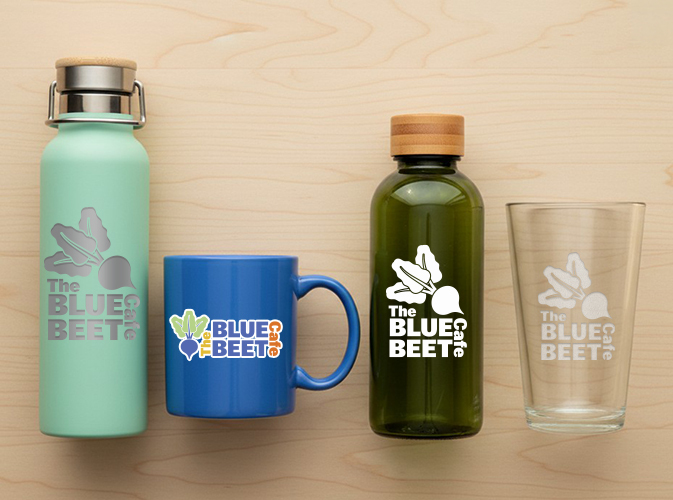
Insulation Types Explained: Which Keeps Drinks Hot (or Cold) Longest?
Insulation is one of the most significant differentiators between drinkware products and one of the most misunderstood. Here is a comparison of the three main insulation types and what they deliver.
-
Vacuum Insulation (Best Performance)
Vacuum-insulated drinkware uses a double-wall construction where all the air between the two walls has been removed, creating a vacuum. Because heat cannot transfer through a vacuum, this method is by far the most effective at maintaining temperature.
- Keeps drinks cold for up to 24 hours
- Keeps drinks hot for up to 12 hours
- Works in extreme temperatures (hot summer days, cold winter commutes)
- Eliminates condensation on the outside of the cup
- Premium feel — the go-to for high-end branded drinkware
How it works: Vacuum insulation eliminates heat transfer through both conduction and convection. The only remaining heat transfer mechanism is radiation, which is minimal — giving vacuum-insulated bottles a dramatic performance advantage over air-gap alternatives.
Vacuum insulation is found almost exclusively in stainless steel drinkware. If you are ordering premium client gifts or high-visibility branded items, vacuum-insulated stainless steel is the clear choice.
-
Double-Wall Insulation (Moderate Performance)
Double-wall insulation uses the same two-wall construction but traps air between the walls rather than removing it. Air is a decent insulator, but it is far less effective than a vacuum.
- Keeps drinks cold for approximately 6-8 hours
- Maintains hot temperatures for 4-6 hours
- More affordable than vacuum-insulated options
- Available in both stainless steel and plastic drinkware
- Reduces but does not eliminate condensation
Double-wall insulated drinkware hits a sweet spot between performance and price. It is a great choice for mid-range corporate gifts and giveaways where you want better-than-average temperature retention without paying for top-tier vacuum performance.
-
Non-Insulated Drinkware (Budget Friendly)
Non-insulated drinkware is single-wall construction, essentially just one layer of material between the liquid and the outside world.
- Little to no temperature retention
- Condensation will form on the outside with cold drinks
- Lowest cost — ideal for large-volume giveaways
- Works well for cold drinks when consumed quickly
- Best use cases: stadium cups, event cups, casual branded merchandise
Quick reference:
If temperature retention matters to your audience, choose vacuum-insulated stainless steel. If budget is the primary driver and the drinkware will be used at an event or consumed quickly, non-insulated plastic delivers the most volume for your investment.
Drinkware Materials Comparison: Stainless Steel, Plastic, Glass & More
The material your drinkware is made from affects everything: insulation performance, durability, weight, branding options, and perceived value. Here is a rundown of the most common drinkware materials, followed by a side-by-side comparison.
-
Stainless Steel
Stainless steel is the gold standard for premium branded drinkware, and for good reason. It is durable, corrosion-resistant, and the only material that supports true vacuum insulation. Food-grade stainless steel (typically 18/8) is safe, odor-resistant, and does not leach chemicals or flavors into beverages.
- Durability: Very high — resists dents and scratches better than plastic or glass
- Insulation: Excellent — supports true vacuum double-wall insulation
- Branding: Best for laser engraving; also works with screen print and UV/digital print
- Feel: Premium — carries a high perceived value in corporate gifting contexts
- Weight: Moderate — heavier than plastic, lighter than glass
- Best for: Premium client gifts, executive team giveaways, high-visibility branded merchandise
-
Plastic (Tritan & Polypropylene)
Plastic drinkware covers a wide range of quality levels. At the premium end, Tritan is a BPA-free, shatter-resistant copolyester that offers excellent clarity and durability. At the budget end, polypropylene (PP) plastic is lightweight and inexpensive but offers less durability and minimal insulation.
- Tritan plastic: BPA-free, shatter-resistant, dishwasher safe, good clarity — ideal for mid-range branded bottles and tumblers
- PP plastic: Lightweight, affordable, and best for high-volume event drinkware.
- Branding: Screen printing, pad printing, and digital printing all work well.
- Best for: Large giveaway campaigns, trade show freebies, and budget-conscious orders.
-
Glass
Glass drinkware has a clean, natural feel that appeals to eco-conscious consumers. It does not impart flavors, making it a popular choice for coffee mugs and wine glasses.
- Taste neutral: Does not absorb odors or flavors.
- Eco-friendly perception: Naturally recyclable and free from plasticizers.
- Branding: Works well with UV/digital printing, screen printing, and sandblasting.
- Drawback: Fragile — not ideal for trade shows or outdoor events where breakage is a risk
- Best for: Corporate office gifts, wine and beer promotional items, and upscale presentations.
-
Aluminum
Aluminum drinkware is lightweight and recyclable, often used for promotional water bottles and cans.
- Lightweight: Often lighter than comparable stainless steel options.
- Recyclable: One of the most recycled materials in the world.
- Branding: Accepts color printing and engraving well.
- Best for: Outdoor brands, eco-conscious campaigns, and sports sponsorships.
Materials at a Glance
Lid Types & the Drinking Experience: Which Lid Works Best?
Lid design is one of the most overlooked factors when choosing promotional drinkware — yet it directly impacts how often and how easily someone uses the product. A great bottle with a frustrating lid will end up unused. Here is an overview of the most common lid types and the situations they serve best.
-
Screw-On Lids
- Best for: Leak-proof storage, carrying in bags, travel
- Provides the most secure, leak-proof seal of any lid type
- Requires two hands to open — less convenient for one-handed drinking
- Often paired with wide-mouth bottles for easy cleaning
- Ideal when the drinkware will be transported in a bag, gym bag, or backpack
-
Flip-Top Lids
- Best for: Commuters, office workers, one-handed drinking on-the-go
- Single-handed operation — simply press a button to flip open
- Many versions are also leak-resistant when locked
- Very popular on travel mugs and insulated tumblers
- Creates a slightly larger sipping opening than a straw lid
-
Straw Lids
- Best for: Workouts, driving, cold beverages, anyone who prefers sipping
- Built-in or removable straw allows easy sipping while in motion
- Keeps lips away from the hot surface of the lid — better for hot drinks too
- Often pairs with wide-mouth or stadium-style cups
- Popular among fitness-oriented demographics and younger consumers
-
Slide Lids
- Best for: Coffee on-the-go, commuter mugs, smaller sip openings
- A small slider covers the sipping hole when not in use
- Common on travel coffee mugs and commuter tumblers
- More splash-resistant than open sip lids
- One-handed slide mechanism popular in commute and office settings
-
Wide-Mouth / No-Lid Options
- Best for: Ice access, easy cleaning, slower-paced drinking situations
- Wide opening makes it easy to add ice, fruit, or supplements to a bottle
- Much easier to clean thoroughly, important for long-term use
- Can use interchangeable lids (straw, screw-on, chug)
- Popular with outdoor and adventure brands
Buyer tip:
For corporate gifting, flip-top lids tend to have the broadest appeal. For fitness or sports-themed giveaways, straw lids are consistently popular. When in doubt, screw-on lids offer the most reliable leak-proof performance.
Branding Methods for Custom Drinkware: Which Imprint Lasts Longest?
How your logo is applied to the drinkware determines how long it will look good and how well it holds up to daily washing and use. There is no universally "best" method. The right choice depends on your drinkware material, budget, artwork complexity, and order volume. Here is a closer look:
-
Screen Printing
Screen printing is one of the most widely used branding methods for promotional drinkware, particularly for plastic cups, bottles, and tumblers. The ink is pushed through a mesh screen directly onto the drinkware surface.
- Best for: 1 to 4 spot colors on plastic and powder-coated stainless steel.
- Color limitation: Each color requires a separate screen. Complex gradients are not ideal.
- Durability: Good. Holds up well with normal use, though repeated dishwasher cycles can cause fading over time.
- Cost: Very cost-effective at volume. Setup costs make small orders pricier per unit.
- Best application: Stadium cups, plastic bottles, powder-coated tumblers, and large-run giveaways.
-
Laser Engraving
Laser engraving uses a focused laser beam to etch your design directly into the surface of the drinkware. On stainless steel, this removes the powder coating or anodized layer to reveal the bare metal beneath, creating a polished silver-toned design against the coated background.
- Best for: Stainless steel drinkware, premium gifts, and executive gifting.
- Durability: Permanent. Will never fade, peel, crack, or wash off.
- Color: Single-tone imprint using the exposed metal color.
- Feel: Premium and tactile with high perceived value.
- Best application: Client gifts, executive drinkware, anniversary awards, and recognition programs.
-
Digital / UV Printing
Digital and UV printing methods apply full-color designs directly to the drinkware surface using UV-cured inks. This allows complex artwork, photographs, and unlimited color gradients.
- Best for: Full-color designs, gradients, photographic images, and detailed artwork.
- Color capability: Unlimited color reproduction.
- Durability: Good. More durable than traditional digital printing, though not as permanent as engraving.
- Material compatibility: Stainless steel, plastic, and glass.
- Best application: Event-specific drinkware, complex logos, and high-impact gifting collections.
-
Pad Printing
Pad printing uses a silicone pad to transfer an inked image from a printing plate onto the drinkware. The flexible pad conforms to curved or irregular surfaces, making it ideal where screen printing is not practical.
- Best for: Curved or irregular surfaces and small logo placements.
- Detail level: Ideal for small, detailed logos.
- Color: Multi-color capability, though complex designs are better suited to digital printing
- Cost: Moderate — works well for small runs on specialty shapes
- Best application: Oddly shaped bottles, mugs with contoured surfaces, small accessory items
Branding method summary:
For maximum longevity and a premium impression, choose laser engraving on stainless steel. For colorful, eye-catching designs at volume, screen printing on plastic or digital printing on steel are excellent options. Match your branding method to both your material and your audience expectations.
How to Choose the Right Drinkware: A Decision Framework
With dozens of combinations of material, insulation, lid type, and branding method available, it helps to anchor your decision around actual use. Follow this framework to quickly narrow your options.
Additional Decision Factors to Consider
- Order quantity: Screen printing has setup fees that favor large orders. Laser engraving and digital printing can be more economical at smaller quantities.
- Audience lifestyle: Corporate office workers tend to prefer tumblers and mugs. Fitness-oriented audiences gravitate toward water bottles with straw or wide-mouth lids.
- Brand positioning: Premium brands should lean into vacuum-insulated stainless steel with laser engraving. Value brands can effectively use screen-printed plastic without sacrificing brand visibility.
- Event context: For outdoor events, choose durable stainless steel. For conference table settings, ceramic mugs or glass tumblers can add a sophisticated touch.
- Budget per unit: Plastic stadium cups can cost under $2 per unit, while vacuum-insulated stainless tumblers may run $10-$30+ per unit. Match your budget to the occasion and relationship value.
Why Branded Drinkware Delivers Outstanding ROI
Beyond the practical considerations of material and insulation, there is a strategic case to be made for why drinkware consistently outperforms other promotional categories as a brand investment.
- Drinkware is used multiple times per day — a coffee mug or water bottle can generate 3 to 5 brand impressions daily just within the owner's immediate environment.
- Items like water bottles and tumblers are often used in public — at the gym, on public transit, in coffee shops — generating brand impressions beyond the original recipient.
- People keep quality drinkware for years. Unlike promotional pens or paper products, a durable tumbler or insulated bottle stays in rotation long after a trade show or event.
- Drinkware aligns with positive daily habits — hydration, coffee rituals, fitness routines — creating positive brand associations through repeated use.
- The utility factor: Recipients are far more likely to keep and use something they find genuinely useful. Drinkware consistently ranks among the top categories of promotional products for retention by recipients
The key to maximizing promotional drinkware ROI is choosing a product your audience will use repeatedly. A well-chosen, high-quality piece of branded drinkware essentially becomes a daily brand touchpoint at a fraction of the cost of paid media impressions.
Ready to Order Custom Branded Drinkware?
Amsterdam Printing offers a full range of custom promotional drinkware, from budget-friendly stadium cups to premium vacuum-insulated stainless steel tumblers. Browse our full collection or contact our team for expert guidance on choosing the right drinkware for your next campaign, event, or corporate gifting program.
FAQs:
-
What is the best material for promotional drinkware?
The best material depends on your goals and budget. For premium corporate gifts where durability and perceived value matter most, 18/8 stainless steel is the top choice — it is durable, corrosion-resistant, and supports vacuum insulation. For large-volume giveaways where cost per unit is the primary concern, BPA-free Tritan plastic offers a good balance of durability and affordability. Glass is an excellent option for desktop mugs and upscale brand presentations where a clean, natural feel aligns with your brand image. In general, stainless steel delivers the best all-around performance across insulation, durability, branding options, and perceived value.
-
Does insulated drinkware really keep drinks hot or cold?
Yes — but the performance varies significantly between insulation types. True vacuum-insulated double-wall stainless steel drinkware is highly effective: it can keep beverages cold for up to 24 hours and hot for up to 12 hours under normal conditions. This performance relies on the vacuum eliminating heat transfer through conduction and convection, with only minimal radiation remaining. Double-wall insulation with an air gap is less effective but still noticeably better than single-wall drinkware, offering roughly 6 to 8 hours of cold retention. Non-insulated plastic or glass drinkware provides minimal temperature retention and is best suited for beverages consumed within a short time of filling.
-
What is the most durable branding method for drinkware?
Laser engraving is the most durable branding method available for promotional drinkware. Because it physically etches the design into the surface of the material — most effectively on stainless steel — the imprint cannot fade, peel, crack, or wash off regardless of how frequently the drinkware is used or cleaned. A laser-engraved logo will look as sharp after years of daily use as it did when the item was first delivered. Screen printing is a close second for durability on plastic drinkware, especially when the items are hand-washed rather than run through a dishwasher repeatedly. For full-color designs where maximum durability is needed, UV/digital printing with UV-cured inks offers a good balance of color fidelity and longevity.
-
Which drinkware is best for hot beverages like coffee?
For hot beverages, the best combination is a vacuum-insulated stainless steel travel mug or tumbler with a flip-top or slide lid. The vacuum insulation keeps coffee hot for extended periods — typically 6 to 12 hours depending on fill level and ambient conditions — while the flip-top or slide lid allows easy one-handed sipping without removing the lid entirely. For desktop use where temperature retention over a longer period is less critical, a ceramic or glass mug remains a popular choice for its clean taste and traditional coffee mug feel. Avoid non-insulated plastic drinkware for hot beverages, as heat will transfer quickly through the walls and the liquid will cool rapidly.
-
What is the difference between a tumbler and a mug?
The primary differences are in shape, handle design, and intended use. A traditional mug is typically ceramic or glass, has a handle, and is designed for desktop use — sitting at a desk or table while drinking. A tumbler is typically a cylindrical, handleless container made from stainless steel or plastic, designed for portability and on-the-go use. Tumblers usually include a lid and are designed to fit in car cup holders. Insulated tumblers maintain temperature far better than ceramic mugs. From a branding perspective, tumblers offer a larger and more versatile imprint area, while mugs offer a classic, familiar presentation that resonates strongly in office gifting contexts.
-
How do I choose promotional drinkware for a large trade show or event?
For large trade shows or events where budget and quantity are the primary drivers, prioritize cost-per-unit and portability. Screen-printed plastic tumblers, stadium cups, or Tritan water bottles typically offer the best value at high volumes. Choose a bold, simple design with 1 to 2 colors to keep screen printing costs low. If your audience is health or fitness oriented, a branded plastic water bottle with a flip-top or straw lid will be better received than a stadium cup. For smaller, more exclusive events where you want guests to take home a premium gift, a vacuum-insulated stainless tumbler with laser engraving signals a level of quality that reflects well on your brand long after the event.
Published: 7/16/26