Most companies choose promotional products by browsing a catalog and picking something that looks appealing. The problem with that approach is that the right promo product for a new employee looks nothing like the product for a trade show prospect — and sending the wrong item to the wrong audience quietly wastes budget while delivering little measurable return. This guide breaks down the four primary audiences for promotional products — employees, clients, prospects, and event attendees — and explains exactly what to give each one, why it works, and how to calibrate your spend for maximum impact.
KEY TAKEAWAYS
- Audience determines effectiveness, so one promotional product does not work equally well across all four recipient groups.
- Employees respond best to high-quality, daily-use items that reflect genuine appreciation and reinforce company culture.
- Client gifts should prioritize perceived value and subtle branding over high logo visibility. The relationship matters more than the impression.
- Prospect giveaways need to be useful enough to keep, timed strategically, and tied to a next step in the sales process.
- Event giveaways should be lightweight, portable, and budget-friendly for volume — and memorable enough to extend brand recall after the event ends.
- Utility drives usage, and usage drives impressions. Promotional items used daily generate far more brand exposure than novelty items that get discarded.
Why Audience Matters in Promotional Products
Promotional products work because of the context in which they are received, the relationship they reinforce, and how often they get used afterward. A $40 vacuum-insulated tumbler is a meaningful recognition gift for an employee who has been with the company for five years. That same tumbler handed to a cold prospect at a trade show is an expensive overreach that may not even make it home in their carry-on.
The four core audiences for promotional products each have fundamentally different goals, different relationships with your brand, and different thresholds for what feels appropriate versus what feels generic or off-target:
- Employees — Internal audience. Goal: build culture, recognize contributions, drive engagement and retention.
- Clients — Existing relationships. Goal: strengthen loyalty, express appreciation, improve long-term retention.
- Prospects — Potential new business. Goal: generate attention, start conversations, create memorable first impressions.
- Event Attendees — Mixed audience at scale. Goal: maximize brand visibility, drive booth traffic, create post-event recall.
DID YOU KNOW?
Research from the Advertising Specialty Institute (ASI) consistently shows that promotional products generate strong recall and positive brand sentiment — but the data also shows that utility is the number one driver of whether a recipient keeps an item. The more useful the product, the longer it stays in rotation, and the more brand impressions it generates over time.
-
Employees
Why Choose Promotional Products for Employees?
Employee swag is inward-facing. Its purpose is not to generate brand awareness in the outside world but to make the people inside your organization feel valued, connected, and proud of where they work. Done well, it reinforces culture, signals that leadership pays attention, and gives employees something they want to use. Done poorly, it becomes a pile of branded items stuffed in a desk drawer.
What Employee Swag Is Actually Trying to Do
The business case for employee-focused promotional products connects directly to engagement and retention. According to Gallup, companies with highly engaged employees outperform those with low engagement by 23% in profitability. While swag alone does not drive engagement, it is a visible and tangible expression of the recognition and appreciation that do. An onboarding kit that makes a new hire feel welcomed on day one, or a quality hoodie given to mark a work anniversary, signals that the organization notices and values its people.
Recommended Products for Employees
- Branded apparel (hoodies, quarter-zips, t-shirts): Apparel is one of the strongest employee swag categories because it converts recipients into walking brand ambassadors. Quality matters here — a well-made hoodie gets worn repeatedly, a cheap one does not. Shop custom apparel
- Premium drinkware (tumblers, mugs, insulated bottles): Daily-use items like tumblers and travel mugs generate consistent impressions throughout the workday. They are among the most retained promotional items in any category. Shop drinkware
- Desk accessories: Branded mousepads, wireless chargers, pen sets, and desktop organizers live on an employee's desk every single workday — generating daily brand impressions in a professional context. Shop desk accessories
- Onboarding kits: A curated welcome kit for new hires — combining apparel, drinkware, a notebook, and a few smaller items — creates an immediate sense of belonging and sets the tone for the employee experience. Shop onboarding gifts
What Works Best for Employees
- ✓ Prioritize quality over quantity — one premium item outperforms a bag of cheap giveaways every time.
- ✓ Make it personal where possible — role-relevant items, milestone-specific gifts, or items tied to a team's identity feel more thoughtful than generic swag.
- ✓ Focus on daily-use utility — the longer someone uses an item, the more it reinforces the positive association with your brand.
- ✓ Avoid over-branding — a subtle logo placement reads as quality; a giant logo across the chest reads as a company uniform.
Pro tip:
The most effective employee swag programs treat gifting as a moment of recognition, not a marketing exercise. The goal is for the employee to feel seen — the brand impression is a byproduct of that.
-
Clients
Why Choose Promotional Products for Clients?
Client gifting operates in a different way than employee swag or event giveaways. The relationship already exists, so the promotional product's job is to deepen it, not introduce your brand for the first time. The best client gifts feel personal and premium, with branding that is present but restrained. Clients who feel genuinely appreciated stay longer, spend more, and refer others. The promotional product is a physical expression of that appreciation.
The Client Gifting Mindset
The mistake most companies make with client gifts is approaching them the same way they approach event giveaways, often prioritizing logo visibility and volume over quality and relevance. Client gifts should feel like gifts, not marketing materials. That means higher perceived value, thoughtful presentation, and branding that enhances the item rather than overwhelming it.
According to research from the Incentive Research Foundation, corporate gifts strengthen business relationships and increase client loyalty when they feel genuine rather than transactional. The perceived value of the gift matters as much as the monetary value — a well-curated $50 gift set can outperform a generic $100 item.
Recommended Products for Clients
- Premium drinkware: Vacuum-insulated stainless steel tumblers and travel mugs with laser-engraved branding are among the most well-received client gifts. They are high-utility, have a long useful life, and feel genuinely premium. Shop drinkware
- Curated gift sets and gift boxes: A thoughtfully assembled gift set — combining drinkware, a quality pen, a notebook, and a few specialty items — elevates the gifting experience and signals that real thought went into the selection. Shop gift sets
- Holiday gifts: The end-of-year gifting window is the single most important client appreciation moment for most businesses. Premium items delivered in branded packaging during November and December reinforce the relationship heading into the new year. Browse the holiday gift guide
What Works Best for Clients
- ✓ Invest in perceived value — the gift should feel like an upgrade from what the client would buy for themselves.
- ✓ Keep branding subtle — a small, engraved logo or embossed mark is more refined than a full-color printed logo across the front.
- ✓ Consider the occasion — anniversary milestones, contract renewals, and project completions are natural gifting moments beyond the holiday season.
- ✓ Personalization amplifies impact — adding the client's name or a specific message to the gift transforms it from a branded item into a personal gesture.
- ✓ Presentation matters — a gift that arrives in quality packaging feels more considered than the same item in a plain poly bag.
Pro tip:
Client gifts work best when they feel like the natural extension of a strong relationship — not like a thinly veiled marketing expense. When in doubt, choose quality over quantity and restraint over logo prominence.
-
Prospects
Why Choose Promotional Products for Prospects?
Prospect-focused promotional products serve a fundamentally different purpose than gifts for employees or clients. Here, the relationship has not been established yet — or is in its earliest stages. The promotional item's job is to capture attention, create a positive first impression, and give the prospect a reason to remember you when the time comes to make a purchasing decision. That requires a different type of product, a different level of spend, and a more deliberate strategy around timing and delivery.
The Prospect Gifting Strategy
The key insight for prospect-focused promotional products is that utility drives retention. A prospect who receives something genuinely useful — a quality tech accessory, a well-made tote bag, a portable charger — is far more likely to keep it than a prospect who receives a novelty item with your logo on it. Every time they use that item, they see your brand. The goal is to get into the daily rotation of someone who has not yet decided to buy from you.
Strategic timing also matters significantly for prospect swag. Items given as a threshold reward — after scheduling a demo, attending a webinar, or requesting more information — feel more earned and are more likely to be retained. They also tie the positive feeling of receiving a gift to an action that moves the prospect further down the funnel.
Recommended Products for Prospects
- Tech accessories (portable chargers, wireless earbuds, charging cables): Technology items are among the highest-retention promotional products because they fill a genuine daily need. A quality branded charging cable or portable battery pack stays in rotation almost indefinitely. Shop tech items
- Useful carry items (tote bags, drinkware): Reusable tote bags and branded drinkware are highly practical, low-cost-per-impression items that prospects will use. Totes are especially effective at trade shows and events where attendees need something to carry materials. Shop bags & totes
- Mailers and direct-send gift campaigns: For higher-value B2B prospects, a carefully chosen item mailed directly to a decision-maker can cut through digital noise in a way that an email never will. A physical package on someone's desk demands attention.
What Works Best for Prospects
- ✓ Lead with utility — the item needs to earn its place in the prospect's daily life to generate ongoing impressions.
- ✓ Coordinate swag with meaningful actions — schedule a meeting, attend a demo, or request information to receive the gift. This increases perceived value and filters for qualified interest.
- ✓ Match item quality to deal size — a $200 tech kit is appropriate for a six-figure enterprise prospect; a $10 branded notebook is more in line for a broader lead generation campaign.
- ✓ Keep your CTA clear — include a card, a QR code, or a follow-up sequence that connects the physical gift to the next step in your sales process.
- ✓ Make it memorable — in a world of digital noise, a physical item that delights or surprises a prospect is genuinely differentiating.
Pro tip:
The best prospect swag is useful enough to keep, high-quality enough to impress, and strategically timed to move the relationship forward. It is a sales tool, not just a marketing expense.
-
Event Attendees
Why Choose Promotional Products for Events & Trade Shows?
Event giveaways operate at a different scale than any other promotional product category. The goals shift from relationship depth to brand breadth — you are trying to maximize visibility, drive booth traffic, and create enough of a memorable impression that attendees think of you when they need what you offer. That requires products that are lightweight enough to carry, inexpensive enough to distribute at volume, and useful enough to make it home rather than being left at the venue.
What Event Giveaways Are Actually Competing Against
At a trade show or large event, your giveaway is competing with dozens of others for space in an attendee's tote bag — and ultimately for space in their home or office afterward. The items that win that competition are not necessarily the most expensive ones. They are the most useful and the most portable. A branded pen that works well and lasts will generate more impressions over the following months than an elaborate branded gadget that gets left on the hotel room desk.
Recommended Products for Events
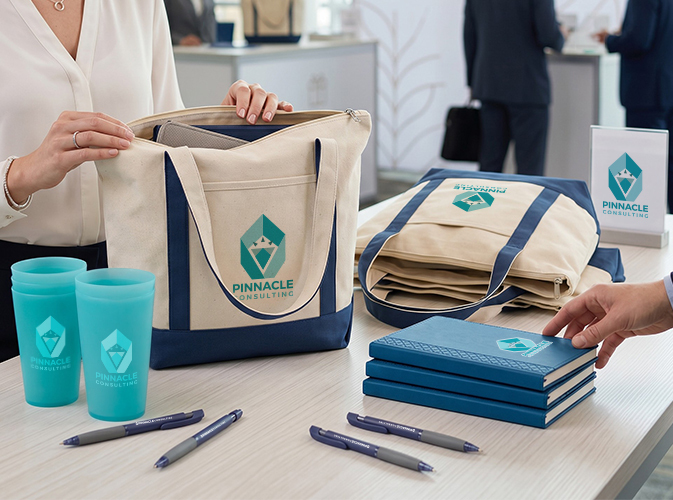
- Tote bags: Tote bags do double duty at events — they serve as the carry vessel for everything else an attendee collects, and they display your logo to everyone in the venue all day long. Shop tote bags
- Pens and notebooks: Pens are the single highest-volume promotional item in the industry because they are universally useful, extremely portable, and generate daily impressions at a very low cost per unit. Pairing a quality pen with a branded notebook creates a practical set that attendees will enjoy. Shop pens | Shop notebooks
- Stadium cups and drinkware: Budget-friendly branded cups are a strong fit for outdoor events, festivals, and high-traffic events where volume and visibility are the primary goals. Shop stadium cups
- Portable and lightweight items: Lanyards, badge holders, phone wallets, and small tech accessories are easy to distribute, easy to carry, and serve a functional purpose at the event itself — increasing the likelihood they make it home.
What Works Best for Events
- ✓ Prioritize portability — if it does not fit comfortably in a bag or pocket, it may not make it past the venue door.
- ✓ Think about post-event life — the best event giveaways are useful enough to be used regularly after the event ends, extending brand impressions for weeks or months.
- ✓ Tier your giveaways — have a high-volume item for general booth visitors and a premium item reserved for qualified leads or scheduled meetings.
- ✓ Make your logo work harder — at events, a clearly visible logo on a tote or apparel item is a brand impression generator for everyone in the building.
- ✓ Order smart for volume — screen-printed plastic drinkware and tote bags offer the strongest cost-per-impression ratio at scale.
Pro tip:
The best event giveaway is the one that makes it home. Focus on utility and portability first, and let the logo do its job over the weeks and months that follow.
Key Differences by Audience: A Side-by-Side Comparison
Use this reference table to quickly align your promotional product strategy with the audience you are trying to reach. Each audience requires a fundamentally different approach to product type, quality tier, and volume.
How to Choose the Right Promotional Product: A 5-Step Framework
With four distinct audience types, dozens of product categories, and a wide range of budget levels, it helps to have a consistent decision framework. Run every promotional product order through these five questions before committing to a product and quantity.
The most common mistake in promotional product selection is starting with the product rather than the audience. Start with who you are trying to reach, define what you want them to feel or do, and work backward to the product from there.
Final tips:
- ✓ One promotional product does not fit all audiences. Align your selection to the recipient, the relationship, and the goal.
- ✓ Utility drives usage, and usage drives impressions. Items people use generate far more brand exposure than novelty items that get tossed.
- ✓ Quality matters most for employees and clients, where the gift reflects the value you place on the relationship.
- ✓ Volume and portability matter most for events, where cost-per-impression and post-event retention are the primary metrics.
- ✓ Prospect swag should be useful enough to earn a place in daily life and timed to a meaningful action in the sales process.
- ✓ Subtle branding wins at the high end. The more premium the context, the more restrained your logo placement should be.
Ready to Build a Smarter Promotional Products Strategy?
Amsterdam Printing offers a full range of promotional products across every audience category — from premium employee onboarding kits to high-volume event giveaways and curated client gift sets. Our team can help you match the right product to the right audience at the right budget. Browse our full catalog or contact us to discuss your next campaign.
Shop all promotional products at AmsterdamPrinting.com
FAQs
-
What are the best promotional products for employees?
The best employee promotional products are high-quality, daily-use items that feel like genuine recognition rather than marketing materials. Top performers include branded apparel (hoodies, quarter-zips, performance tees), premium drinkware (insulated tumblers, travel mugs), desk accessories, and curated onboarding kits. Quality is the most important variable — a well-made item signals that the company values its people, while a cheap item can have the opposite effect. For milestone moments like work anniversaries or promotions, personalized or role-relevant items tend to land better than generic swag.
-
What is the difference between client swag and prospect swag?
Client swag and prospect swag serve fundamentally different purposes. Client gifts are about deepening an existing relationship, so they should feel premium, personal, and appreciative, with subtle branding that enhances rather than dominates the item. Prospect swag is about earning attention and creating a memorable first impression with someone who has not yet committed to your brand. Prospect items should prioritize daily utility, so they stay in rotation and generate repeated impressions. Budget allocation differs too: client gifts typically warrant a higher per-unit investment, while prospect giveaways balance quality against the volume needed to support a lead generation campaign.
-
What are the most effective event giveaways for trade shows?
The most effective trade show giveaways are items that are useful at the event itself and portable enough to make it home afterward. Tote bags consistently rank as one of the top event giveaways because they serve as carry vessels for everything else an attendee collects — displaying your brand to everyone in the venue all day. Quality pens and branded notebooks are also reliable performers because of their universal utility and low per-unit cost. For premium lead capture, a tiered approach works well: a high-volume item for all booth visitors and a more premium item reserved for qualified conversations or scheduled follow-up meetings.
-
Are promotional products worth the investment?
Yes — when matched to the right audience and selected for utility rather than novelty. Research from the Advertising Specialty Institute consistently shows that promotional products generate strong brand recall and positive sentiment among recipients. The key variable is utility: items that get used daily (drinkware, apparel, tech accessories, pens) generate far more impressions over time than items that get discarded or stored away. When calculated on a cost-per-impression basis, high-retention promotional products often outperform digital advertising channels at a fraction of the cost.
-
What promotional items get used the most?
According to multiple industry studies, the promotional items with the highest retention and daily use rates are drinkware (particularly insulated tumblers and travel mugs), branded apparel (especially outerwear and performance tops), writing instruments (pens and pencils), bags (totes and backpacks), and technology accessories (charging cables, power banks, earbuds). The common thread across all of these is genuine daily utility; people keep and use items that solve a recurring need. Novelty items and tchotchkes, regardless of how creative they are, tend to have significantly lower retention rates.
-
How much should I spend on promotional products per person?
Budget benchmarks vary significantly by audience. For event giveaways distributed at scale, a per-unit cost of $2 to $8 is typical and appropriate. For prospect outreach campaigns targeting qualified leads, $10 to $25 per item is a reasonable range for items like tech accessories or quality drinkware. For employee gifts and recognition, $20 to $50 per person is a common range, with premium milestone gifts reaching $75 to $150 or more. For client gifts, $40 to $100+ is appropriate depending on the relationship value and the occasion. In all cases, the metric that matters most is not the per-unit cost but the cost-per-impression generated by the item over its useful life.
Published: 7/16/26