

Launching an employee or partner merch store feels like a win. It centralizes branded merchandise, gives teams access to approved gear, and supports consistency across locations and partners.
But here’s the reality: A store that’s live isn’t necessarily a store that’s working.
To understand whether your merch program is driving engagement and staying cost-efficient, you need to track key performance indicators (KPIs). That means measuring more than just orders place but also engagement, redemption, and total program costs.
Defining What Success Looks Like
Success isn’t measured by how many SKUs sit in your store or how quickly it launched. A high-performing merch store supports bigger goals:
- Stronger employee engagement and retention
- Greater partner loyalty and brand alignment
- Consistent, on-brand visibility across every touchpoint
KPIs give you clarity by indicating if your store is creating real value or simply existing in the background.
Engagement KPIs — Are People Actually Using the Store?
Engagement tells you whether your audience is paying attention — even before they place an order.
Key metrics to watch:
- Store visits and unique users
- Repeat visits
- Click activity on featured collections
- Time spent browsing
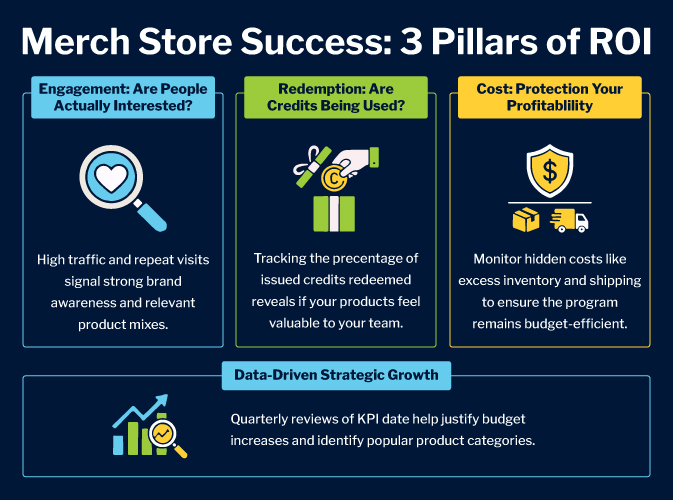
High engagement typically signals strong awareness, relevant products, and effective communication around the program.
Potential red flags are when traffic is high but orders are low, or when engagement spikes only after reminder emails. That usually points to product mix, pricing or communication gaps.
If people are browsing but not buying, something needs adjusting.
Redemption KPIs — Are Allocated Credits Being Used?
If your store includes employee allowances, reward points or partner credits, redemption rate is critical.
Important measures include:
- Percentage of issued credits redeemed
- Average redemption value per user
- Time between credit issuance and redemption
- Partial versus full credit usage
Low redemption often indicates that products don’t feel valuable, pricing leaves awkward leftover balances, or navigation feels complicated.
Improving redemption can be as simple as refreshing assortments, offering varied price points, or simplifying the user experience.
When credits go unused, engagement and budget efficiency both suffer.
Cost KPIs — What Is the Program Really Costing?
Merch programs involve more than product price.
Core cost metrics include:
- Average order value
- Cost per redemption
- Cost per active user
- Fulfillment and shipping expenses
Hidden costs can quietly erode ROI:
- Excess inventory
- Rush production
- Returns and exchanges due to sizing issues
Smart programs balance bulk purchasing with on-demand options, review assortments quarterly, and monitor underperforming items before they drain budget.
Cost visibility prevents surprises and keeps your program sustainable long term.
Finding the Right Balance
Focusing on one KPI in isolation rarely works. For example, high engagement with low redemption signals missed opportunity. And high redemption with rising costs indicates inefficiency.
The strongest merch stores hit a balanced sweet spot:
- Products feel desirable
- Budgets are used effectively
- Costs remain predictable
- Participation continues steadily over time
Turning Data Into Action
Reviewing performance quarterly keeps your store evolving. Data can help you:
- Retire slow-moving items
- Expand popular categories
- Adjust credit amounts
- Introduce seasonal or limited collections
KPIs also help justify expanding your program or increasing budget because you can clearly demonstrate engagement and impact.
Rather than feel static, a merch store should grow alongside your workforce and partner network.
The Bottom Line with Company Store KPIs
Employee/partner merch stores are powerful tools for engagement, recognition, and brand consistency — but only when managed intentionally. It’s important to:
- Track engagement to measure interest
- Track redemption to measure value
- Track costs to protect sustainability
When these three metrics work together, your merch store becomes a strategic asset.
If you’re evaluating your current program or building a new one, the right structure and reporting framework can make all the difference. Amsterdam’s Online Company Stores are designed to help you simplify management, control costs, and keep participation strong — all while delivering branded merchandise your people want to wear and use.