
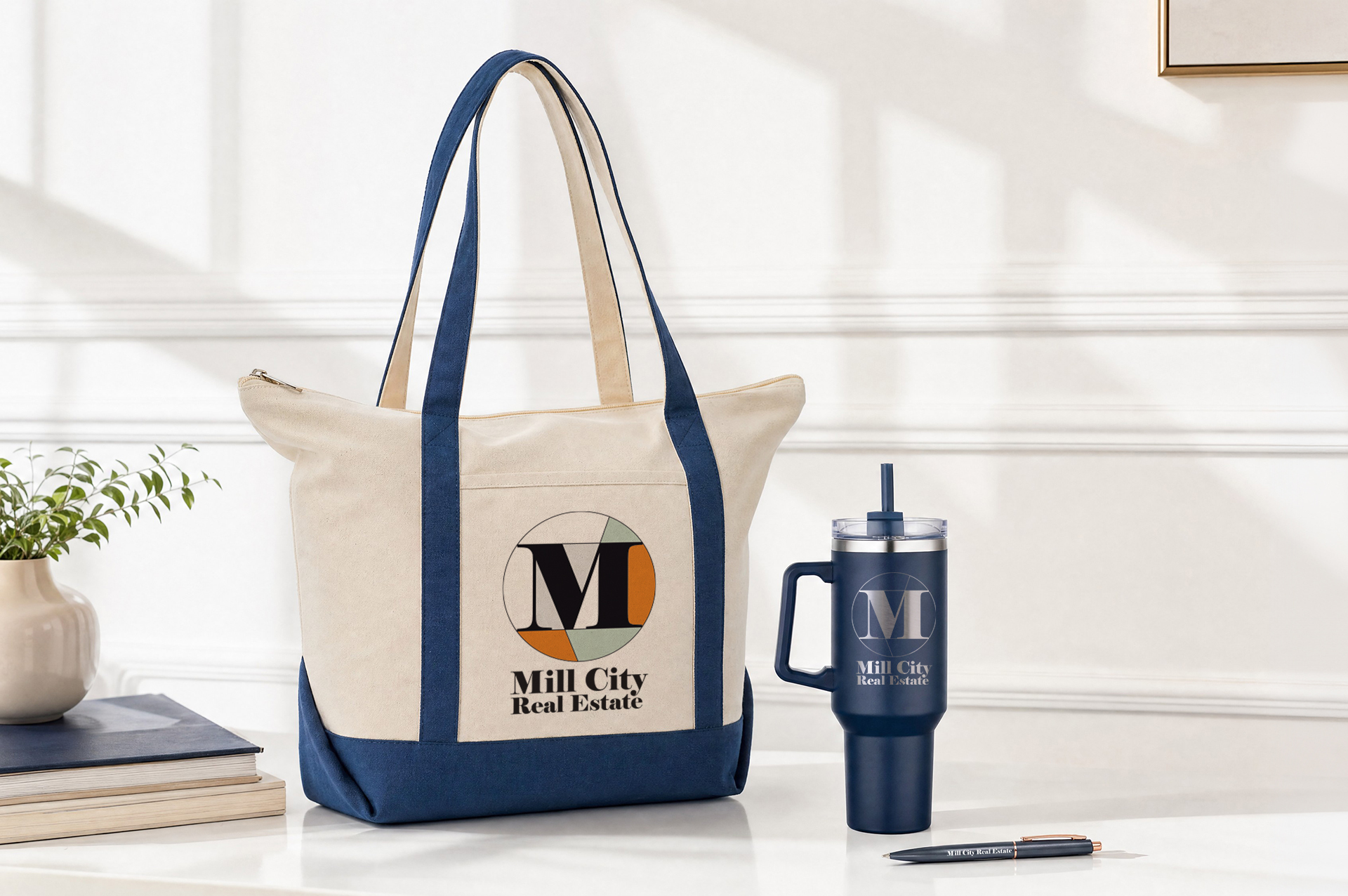
It sounds counterintuitive, but spending more on promotional products can cost you less. This article breaks down the cost-per-use framework and applies it to the most popular swag categories: drinkware, bags, tech accessories, and pens. You’ll see exactly why a $30 insulated tumbler outperforms a $5 plastic bottle, why a quality tote outlasts a throwaway bag, and how to stretch your promotional budget further and get more impressions for every dollar you spend.
KEY TAKEAWAYS:
- The real measure of swag value isn’t the price tag, but cost-per-use: what you pay divided by how many times it’s used.
- Budget items often have a higher cost-per-use than premium ones because they get tossed, ignored, or forgotten quickly.
- Premium drinkware, bags, and tech accessories are used daily, generating far more brand impressions over their lifetime.
- 79% of people say they’re more likely to do business with a brand that gave them a high-quality promotional item.
- Subtle, tasteful branding on a quality product dramatically increases the chances it gets used in public — where it counts most.
The Cost-Per-Use Framework: A Smarter Way to Evaluate Swag
Most promotional product decisions start with the same question: “How much does it cost?” But that’s not the right approach. The better question is: “How much does each use cost?”
The formula is simple:
Cost-Per-Use = Item Price ÷ Number of Times Used
A $5 plastic water bottle that gets used twice and thrown out has a cost-per-use of $2.50. A $25 insulated stainless steel tumbler that someone uses every workday for two years? That’s roughly $0.05 per use — and your brand logo rides along for every one of those 500+ uses.
Budget vs. Premium: What Happens in the Real World
Let’s get specific. Here’s how budget and premium items compare across the most popular swag categories:
1. Custom Drinkware: Plastic Bottle vs. Insulated Tumbler
- Budget pick: A plastic water bottle ($4–6). It’s fine. People take it, maybe use it at an event, and it ends up in a cabinet or the recycling bin within a few weeks.
- Premium pick: A vacuum-insulated stainless steel tumbler ($20–30). It keeps coffee hot and water cold. People use it every day — at their desk, in the car, at the gym. It’s the kind of item that earns a permanent spot in someone’s daily routine.
The tumbler costs four to five times more upfront. But if it’s used 300 times versus the plastic bottle’s 5, the cost-per-use isn’t even close.
2. Promotional Bags: Flimsy Tote vs. Quality Canvas or Branded Backpack
- Budget pick: A thin, non-woven polypropylene tote ($2–4). Great for stuffing with trade show collateral. Not great for much else. Most end up in a pile with other event totes or get tossed entirely.
- Premium pick: A sturdy canvas tote or a well-made branded backpack ($15–40). These are items people choose to carry. A quality tote becomes a grocery bag, a gym bag, a work bag. A branded backpack can travel with someone for years.
Bags are one of the highest-visibility swag items available — but only when they’re good enough that people want to be seen carrying them.
3. Custom Tech Accessories: Generic Charger vs. Quality Multi-Use Cable or Power Bank
- Budget pick: A basic single-use charging cable ($3–5). Useful in the moment, but with so many cables already floating around, it rarely gets used long-term.
- Premium pick: A multi-port charging cable, a quality wireless charger, or a compact power bank ($15–35). These solve real, daily problems. People keep them at their desk, in their bag, or in their car — and see your logo every time.
Tech accessories earn their place because they solve a problem people encounter every single day. Premium tech items don’t just get kept — they get used.
4. Promotional Pens: The Classic Budget Item — Done Right
Not every item needs to be premium to deliver value. Pens are a rare exception where volume works in your favor (but quality still matters.) A pen that writes smoothly gets kept and passed around while a scratchy one gets tossed.

The Hidden Variable: Quality Items Get Used in Public
Here’s something the cost-per-use math doesn’t fully capture: Where items get used matters as much as how often.
A cheap branded item might get used at home, out of sight. A quality item — a well-made tumbler, a sharp-looking bag, a useful piece of tech — travels. It goes to the office, the coffee shop, the airport. Every public use is an organic brand impression that no ad buy can replicate.
79% of consumers say they’re more likely to do business with a brand that gave them a high-quality promotional item. A well-made item communicates that your brand is serious, thoughtful, and worth paying attention to. A cheap item sends the opposite message, even when that wasn’t the intent.
How to Get Premium Quality Without Breaking Your Budget
Going premium doesn’t mean writing a blank check. Here’s how to make smarter choices that stretch your dollars further:
- Order strategically, not in bulk for bulk’s sake. A smaller quantity of high-quality items will outperform a large quantity of forgettable ones. Think about who you’re giving to — and deliver accordingly.
- Use subtle, tasteful branding. A discreet logo on a quality item gets used more than a logo plastered across every surface. Understated branding turns a product into something people are happy to carry in public.
- Focus on daily-use items. Drinkware, bags, and tech accessories incorporate naturally into people’s routines. The more seamlessly an item fits someone’s day, the more impressions it generates.
- Match the item to the audience. A premium insulated tumbler may be perfect for a corporate audience whereas a quality canvas tote may resonate better with a creative or lifestyle brand’s crowd.
- Think like an advertiser. A branded item used daily for two years isn’t a giveaway but a two-year ad placement. Evaluate it accordingly.
The Bottom Line with Premium vs. Budget Decisions
Budget swag isn’t cheap — it just looks that way on the invoice. When you factor in how often an item gets used, quality wins almost every time.
Explore Amsterdam Printing’s full collection of premium promotional products and put your brand on something worth keeping.
FAQS:
1. What is cost-per-use, and why does it matter for promotional products?
Cost-per-use (CPU) is the item’s price divided by the number of times it’s used. It’s a more accurate measure of value than upfront cost alone. A $25 tumbler used 400 times costs $0.06 per use. A $5 plastic bottle used 4 times costs $1.25 per use. The tumbler delivers far more brand impressions at a fraction of the per-use cost.
2. Which swag categories offer the best cost-per-use value?
Drinkware, bags, and tech accessories consistently top the list. These are items people use daily, carry in public, and hold onto for months or years. Premium versions — insulated tumblers, quality totes, multi-use charging cables — generate the highest number of impressions relative to their cost.
3. Is premium swag worth it for large-scale giveaways with big audiences?
Not always, and that’s okay. For high-volume, general-audience situations, a tiered approach works well: low-cost essentials like pens and lanyards for general distribution, and premium items reserved for qualified leads, VIPs, or valued clients. Concentrating spend on the people most likely to become customers is almost always the right call.
4. Does branding style affect how often a promotional product gets used?
Significantly. Items with subtle, tasteful logos are far more likely to be used in public settings than items with oversized or overly promotional branding. A quality product with a discreet logo becomes something people actively choose to use. An over-branded item — even a high-quality one — can feel like a walking advertisement that recipients are reluctant to carry.
5. How do I make the case for spending more on fewer, better items?
Lead with the math. Show the cost-per-use comparison side by side and let the numbers speak for themselves. Then add the brand perception angle: 79% of consumers are more likely to do business with a brand that gave them a high-quality item. A smaller quantity of premium swag that gets used and remembered is a stronger investment than a large quantity of forgettable items that get discarded.